Quick Answer
| The green card medical exam is a health screening required by U.S. Citizenship and Immigration Services for almost everyone applying for permanent residence from inside the United States. A USCIS-designated civil surgeon performs it and records the results on Form I-693, Report of Immigration Medical Examination and Vaccination Record. The exam covers your medical history, a head-to-toe physical, a mental health and substance use assessment, lab tests for tuberculosis and certain sexually transmitted infections, and a review of your vaccination record against the CDC schedule. It takes roughly 30 to 60 minutes. |
The green card medical exam is a health screening required by U.S. Citizenship and Immigration Services for almost everyone applying for permanent residence from inside the United States. A USCIS-designated civil surgeon performs it and records the results on Form I-693, Report of Immigration Medical Examination and Vaccination Record. The exam covers your medical history, a head-to-toe physical, a mental health and substance use assessment, lab tests for tuberculosis and certain sexually transmitted infections, and a review of your vaccination record against the CDC schedule. It takes roughly 30 to 60 minutes.
If you are in the US and trying to adjust status, the medical exam is one of the few steps in the green card process you cannot do yourself, cannot rush, and cannot fix later without cost. It is also one of the most commonly done incorrectly. USCIS rejects and delays applications every week over a wrong form edition, a missing signature, an opened envelope, or a blank vaccine section.
The rules have also changed four separate times between December 2024 and July 2025. But only a few people know about these updates. But this guide is written by our team that performs these exams at iMed Urgent Care. and discusses all the facts that you should know.
What is Form I-693?
Form I-693 is the official USCIS document that records the results of your immigration medical exam. It is the paperwork proof that you are not inadmissible to the United States on health-related grounds under section 212(a)(1) of the Immigration and Nationality Act. Only a USCIS-designated civil surgeon can complete and sign it. There is no USCIS filing fee for Form I-693 itself but you have to pay the clinic for the exam.
The form documents four things:
-
Communicable diseases such as active tuberculosis, syphilis, gonorrhea, and Hansen’s disease.
-
Physical or mental conditions with harmful behavior, current behavior or a risk of it happening again.
-
Drug abuse or addiction based on federal rules, not state laws.
-
Vaccination status based on the CDC’s required vaccination schedule.
If all four sections are clean, the civil surgeon signs the form, seals it in an envelope, and hands it to you. That envelope is what USCIS wants.
The Current Form Edition Matters
USCIS accepts only the 01/20/25 edition of Form I-693 for any form a civil surgeon signs on or after July 3, 2025. The edition date is printed at the bottom of every page in mm/dd/yy format. Forms on the older 03/09/23 edition are now rejected outright.
Two practical consequences. First, if you downloaded a blank I-693 months ago, download it again. Second, if all pages of your printed form then do not carry the same edition date and visible page numbers, USCIS can reject the package. Any competent civil surgeon's office will supply the current edition but check it yourself before you leave.
Who Needs a Green Card Medical Exam?
You generally need Form I-693 if you are filing Form I-485, Application to Register Permanent Residence or Adjust Status, from inside the United States. This includes most green card applicants, such as family-based, employment-based, diversity visa, VAWA, and many humanitarian applicants.
You need a full exam if you are:
-
A family-sponsored adjustment applicant like a spouse, parent, child, or sibling of a U.S. citizen or LPR
-
An employment-based adjustment applicant (EB-1 through EB-5)
-
A diversity visa lottery selectee adjusting inside the U.S.
-
An asylee applying for adjustment after one year
-
A VAWA self-petitioner, U visa, or T visa adjustment applicant
-
A registry or special-category applicant where USCIS requests it
You need only a partial I-693 (vaccination record only) if you are:
-
Refugees who already completed an overseas medical exam with a panel physician.
-
K-1 fiancé(e) visa holders who completed an overseas exam within the past year.
-
Derivative asylees whose overseas medical exam is still valid and on file.
You do not need one if you are:
-
U.S. citizens or lawful permanent residents
-
Immigrant visa applicants outside the U.S. as they complete the medical exam with a Department of State-approved panel physician using a different process.
-
Renewing a green card (Form I-90) or applying for naturalization (Form N-400)
If you are not sure about which category you fall into, check with your attorney before booking. This can help you avoid paying for a full exam when you only need a vaccination assessment.
Civil Surgeon vs. Panel Physician: What's the Difference?
A civil surgeon is a physician designated by USCIS to perform immigration medical exams inside the United States. On the other hand, a panel physician is designated by the U.S. Department of State to perform them outside the United States for consular immigrant visa processing. They follow related but separate CDC Technical Instructions and complete different paperwork.
Your regular family doctor is not able to perform this exam. Only a USCIS-designated civil surgeon can complete Form I-693. These doctors are approved by USCIS and receive a Civil Surgeon Identification Number (CSID) for the form.
Two ways to verify a provider before you book:
-
Use the official USCIS "Find a Doctor" tool at my.uscis.gov/findadoctor and search your ZIP code
-
Ask the clinic directly whether the physician holds a current CSID
iMed Urgent Care is a USCIS-designated civil surgeon practice serving Columbus, Grove City, and Central Ohio. Our immigration physical exam service completes the entire process from exam, labs, vaccines, and sealed form all in-house.
What Happens During the Green Card Medical Exam: Step by Step
The exam usually takes about 30 to 60 minutes. You do not need to fast or stay in the hospital. Let’s show you what happens step by step:
Check-In and ID Verification
You will need a government-issued photo ID, such as a passport, driver’s license, state ID, or employment authorization document. The civil surgeon must confirm your identity before the exam.
Medical History Review
The civil surgeon will ask about your past illnesses, surgeries, hospital stays, chronic conditions, medications, TB testing, mental health, and substance use. Answer honestly. Conditions like diabetes, asthma, or high blood pressure do not automatically make you inadmissible.
Physical Examination
The exam includes basic checks of your vital signs, eyes, ears, nose, throat, heart, lungs, abdomen, skin, lymph nodes, and extremities. A basic neurological check can also be performed.
Mental Health and Substance Use Assessment
The civil surgeon checks for physical or mental conditions linked to harmful behavior toward yourself, others, or property. This is usually a clinical conversation rather than a psychological test. Conditions such as depression, anxiety, or ADHD without harmful behavior are not automatically an immigration issue.
Laboratory Testing
You also need blood tests and when required, a urine sample. The specific tests depend on your age and immigration requirements. At iMed Urgent Care, Ohio, testing is available through the in-house lab, so you don’t need to visit another facility.
Vaccination Review
The civil surgeon reviews your vaccination records and compares them with the CDC immigration vaccination requirements for your age. You will receive any vaccines you are missing and currently required to get.
Form Completion and Sealing
After the required results are complete, the civil surgeon fills out and signs Form I-693. The form is placed in a sealed envelope and you receive the sealed envelope along with a copy for your records.
Required Tests for the Green Card Medical Exam
Testing depends on your age at the time of the exam and follows the CDC’s Technical Instructions for Civil Surgeons. Here are the current requirements:
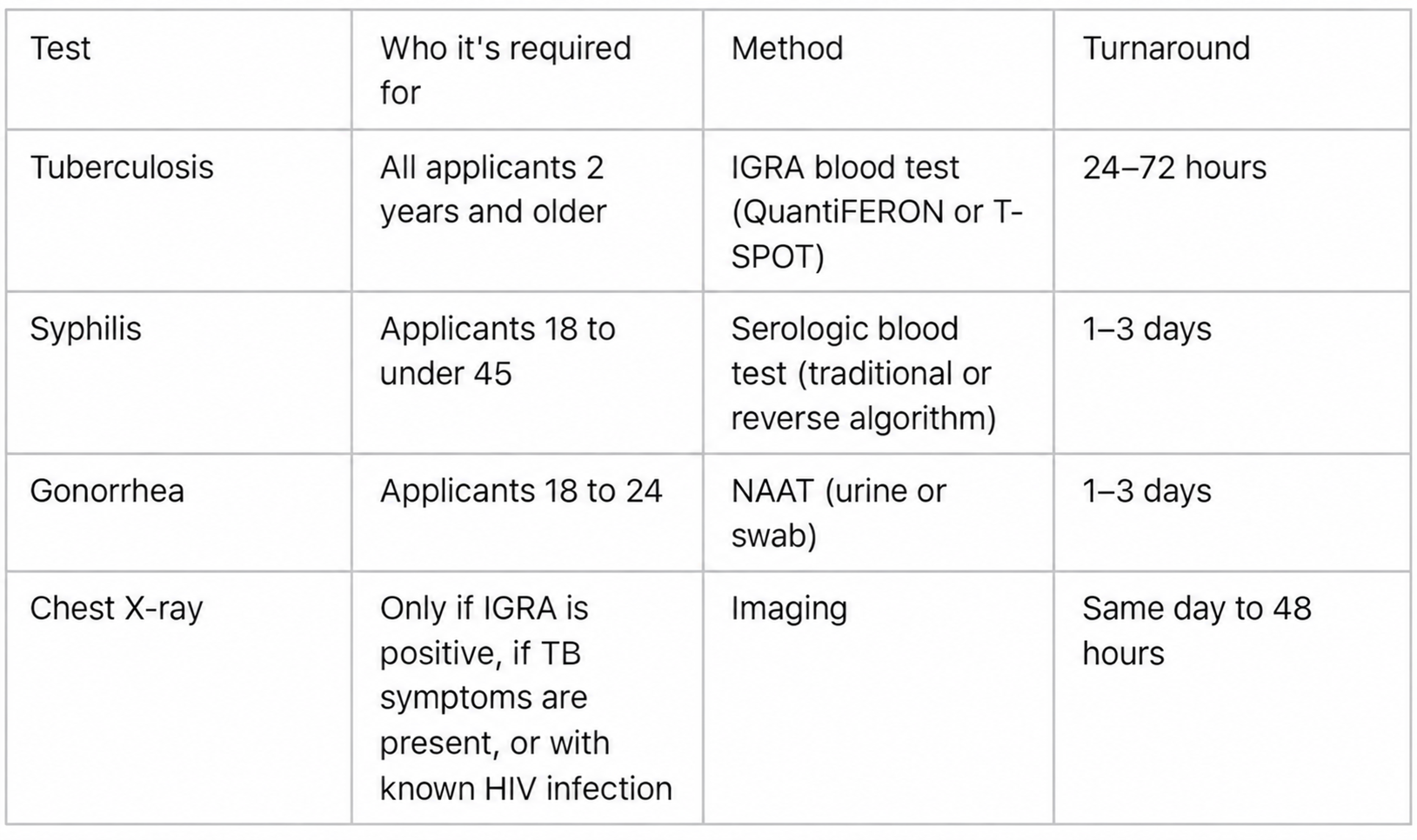
Applicants outside the stated age ranges are tested only if the civil surgeon has clinical reason to suspect infection.
The TB test: what changed and what a positive result means
For applicants age 2 and older, CDC requires a TB blood test (IGRA) instead of the old skin test. Children under 2 are usually screened through their medical history and physical exam.
A positive IGRA does not mean you failed. You will need a chest X-ray. If it is normal and you have no symptoms, it is considered latent TB (Class B2), which is not contagious and does not prevent you from getting a green card.
Only active, infectious TB (Class A) must be treated before USCIS can approve the application.
Syphilis and gonorrhea testing
Both tests must be ordered by the civil surgeon during your exam. Results from your personal doctor, an outside clinic, or a previous lab visit are not accepted.
For syphilis, all required tests must use the same blood sample.
A positive result does not automatically mean denial. It can usually be treated, and the civil surgeon will document the treatment on Form I-693 before signing it.
What the exam does NOT include
The immigration medical exam does not routinely include HIV testing, drug screening, pregnancy testing, or dental, vision, hearing, cholesterol, or genetic tests. It also does not assess your general fitness or BMI for immigration purposes. Additional tests may be ordered only when clinically necessary.
Required Vaccines for a Green Card in 2026
The CDC requires proof of age-appropriate vaccinations or immunity for 15 diseases. COVID-19 is no longer required for immigration medical exams. The required diseases include diphtheria, tetanus, pertussis, polio, measles, mumps, rubella, rotavirus, Hib, hepatitis A and B, meningococcal disease, varicella, pneumococcal disease, and influenza. Not every applicant needs all 15 vaccines because requirements depend on age.
Vaccine requirements by age
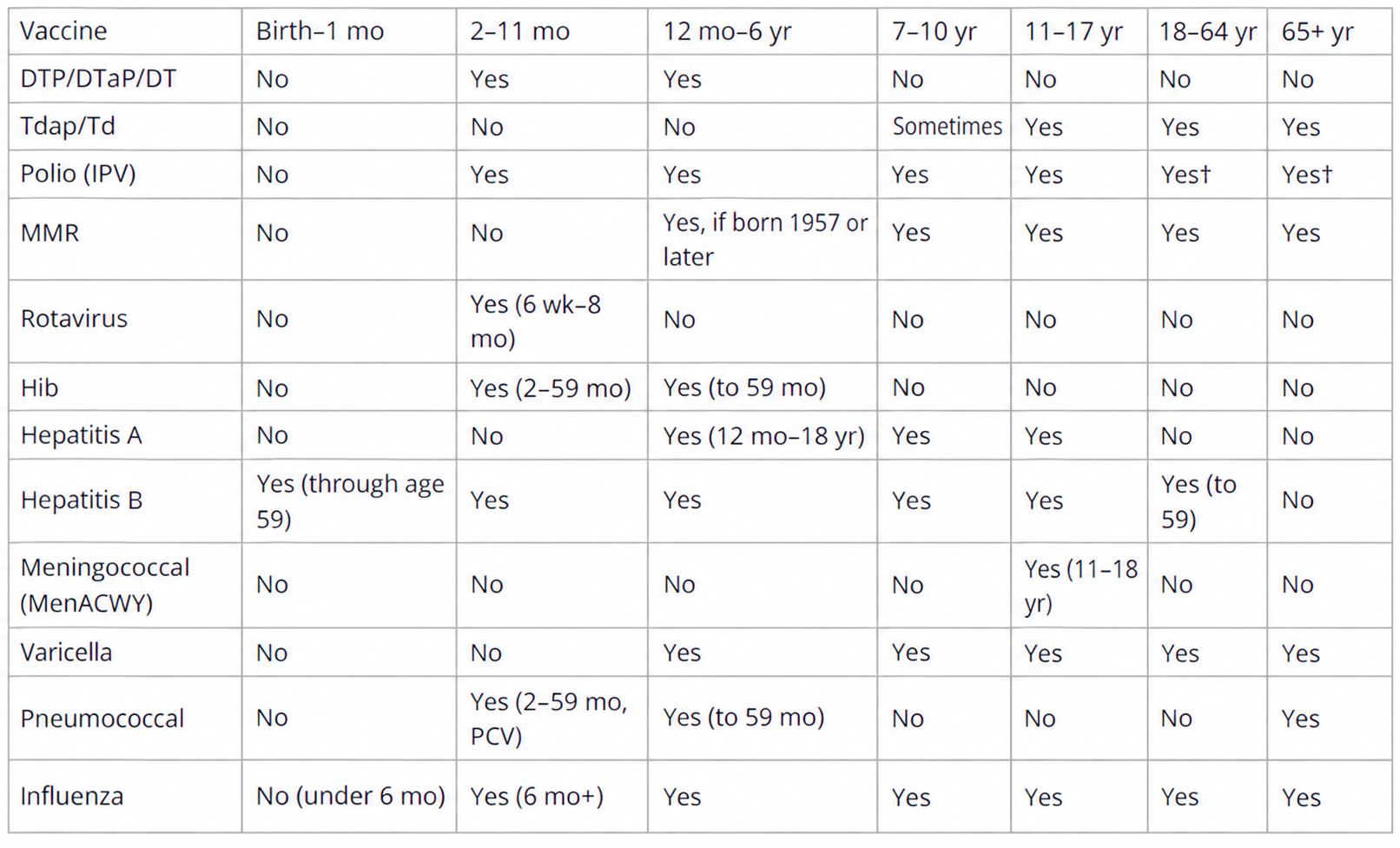
Children ages 7–10 need a Tdap dose based on their vaccination history. Adults without proof of a complete polio vaccine series need additional doses based on CDC guidance.
Flu vaccination is required only when the vaccine is available in the U.S. If you have your exam outside flu season, the civil surgeon can document that no flu vaccine is required.
You usually do not need to complete the entire vaccine series during your immigration medical exam. You only need the next dose that is currently due based on your age and vaccination history.
Some vaccines, such as hepatitis B, take months to complete. You do not have to finish the entire series before filing. The civil surgeon gives you the next dose that is currently due and documents that there is not enough time to complete the series. You can receive the remaining doses later from your regular doctor.
Records, Translations, and Titers
-
Bring written records. Vaccine doses must have a clear date. Self-reported doses without records are not accepted.
-
Foreign records are accepted. Bring your original vaccination card or booklet if the vaccines were given outside the U.S.
-
Translate foreign records. Records in another language should have a reliable English translation.
-
Titers can help. Blood tests can show immunity to measles, mumps, rubella, hepatitis A, hepatitis B, polio, and varicella. This may save you from repeating vaccines.
-
Chickenpox history can count. A reliable history of having chickenpox can sometimes replace the varicella vaccine if it meets CDC requirements
Save on vaccine costs. For Columbus applicants, vaccines can be cheaper at a retail pharmacy or Columbus Public Health. Get them before your exam if needed, and bring the printed records. The civil surgeon will use those records to complete the vaccination section of Form I-693.
I-693 validity in 2026: the rule that keeps changing
This is the point most of the articles miss. Here is the complete timeline and the rule that applies today.
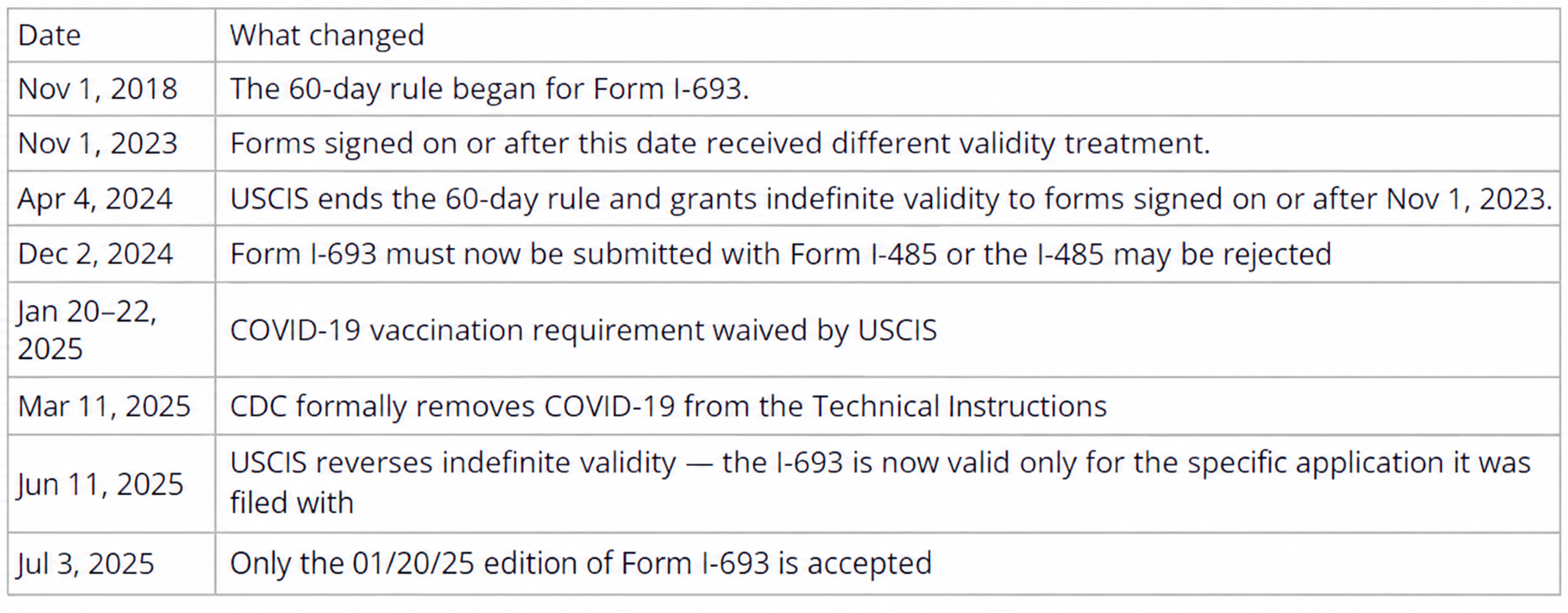
The rule as of today:
A Form I-693 signed on or after November 1, 2023 is valid only for the specific I-485 application it was submitted with. It remains valid while that application is pending, but if the I-485 is denied or withdrawn, you will generally need a new medical exam. The old 60-day signature rule no longer applies. Forms signed before November 1, 2023 follow the older two-year validity rule.
Green card medical exams in Columbus and Grove City, Ohio
iMed Urgent Care is a USCIS-designated civil surgeon practice with three Central Ohio locations in:
We offer the complete immigration medical exam in one place, including the physical exam, required lab tests, vaccines, and sealed Form I-693. Our $299 flat-rate exam, in-house lab, same-day and next-day appointments, and 7-day walk-ins make the process simple and convenient.
Call us at (614) 295-4302 or email info@imedurgentcare.com to request an appointment or visit us during open hours.
FAQs
Can you fail a green card medical exam?
There is no simple pass or fail. The civil surgeon documents your findings and classifies them. Issues such as syphilis, gonorrhea, active TB, or missing vaccines can often be treated or corrected. Drug abuse or addiction and a mental disorder linked to harmful behavior can create immigration concerns and may require help from an immigration attorney.
How much does the green card medical exam cost?
USCIS does not charge a fee for Form I-693. Civil surgeon fees usually range from $150 to $500, plus vaccines or additional tests. At iMed Urgent Care, the exam, required labs, and Form I-693 cost $299, with vaccines charged separately.
Is the immigration medical exam covered by insurance?
Usually not. Many insurance plans do not cover immigration exams because they are required for an immigration application. Some plans cover certain vaccines or lab tests. Check with your insurance company before your appointment.
How long is Form I-693 valid in 2026?
A Form I-693 signed on or after November 1, 2023 is valid for the specific application it was submitted with while that application is pending. If the I-485 is denied or withdrawn, you generally need a new exam.
What vaccines are required for a green card?
Required vaccines depend on your age and vaccination history. They cover diseases such as measles, mumps, rubella, polio, hepatitis A and B, varicella, influenza, and others. COVID-19 vaccination is no longer required for the immigration medical exam. You generally only need the next dose currently due in a vaccine series.
Does legal marijuana use in Ohio affect my green card?
It can. Marijuana remains illegal under federal law, even where it is legal under state law. If this applies to you, do not lie about your history but consider speaking with an immigration attorney before your medical exam.