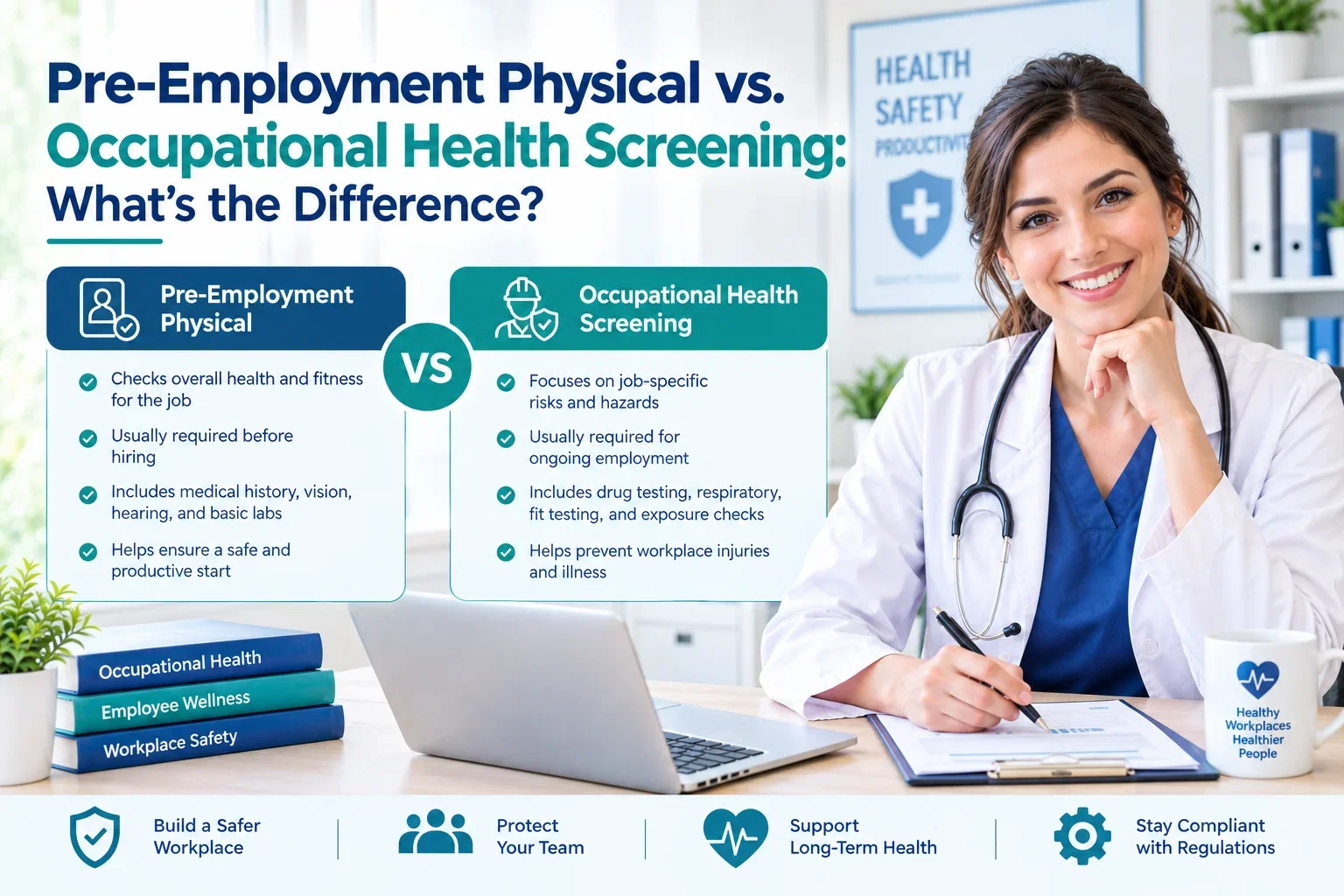
Quick Answer: Pre-Employment Physical vs. Occupational Health Screening
| A pre-employment physical is a one-time medical exam given to a new hire after a conditional job offer. Its purpose is to confirm the person can safely do the job. Occupational health screening is the broader term. It covers every work-related health check an employer can use, including pre-employment exams, ongoing medical surveillance, respirator clearance, hearing tests, drug and alcohol tests, DOT physicals, and return-to-work exams.In short: a pre-employment physical is one type of occupational health screening. Occupational health screening continues for as long as the job carries a health risk. |
What Is a Pre-Employment Physical?
A pre-employment physical is a medical exam that a candidate completes after receiving a conditional job offer and before starting work. You can also hear it called a:
-
Post-offer medical exam
-
Pre-placement physical
-
Pre-employment medical exam
-
Employment physical
-
Fit-for-duty exam (for a new hire)
The purpose of this exam is to make sure you can do the main tasks of your job safely without putting yourself or others at risk. For example, a warehouse job that requires regular lifting needs different health checks than an office job.
What Is Usually Included?
The exact pre-employment exam depends on the job and the employer's request. Many pre-employment physicals include:
-
Medical history review: past illnesses, surgeries, injuries, current medicines
-
Vital signs: blood pressure, heart rate, height, weight
-
Vision check: needed for drivers, machine operators and many trades
-
Hearing check: common in loud or safety-sensitive roles
-
Physical exam: heart, lungs, joints, spine, strength and range of motion
-
Lab work, if requested: urine tests or blood tests
-
Job-specific checks: lifting or agility tests for physical roles
What Is Usually Not Included?
A pre-employment physical does not automatically include a drug test. A drug screen is a separate test and employers order it separately. It also does not include special exams such as a respirator clearance or a DOT physical unless the employer requests them.
If you want to understand panels and what they detect, read our guide on 5-panel vs. 10-panel drug tests.
What Is Occupational Health Screening?
Occupational health screening means medical checks that help keep workers safe and ensure the workplace follows safety rules. Employers choose the right checks based on the risks of each job.
Screening can happen at any stage:
-
Before work starts: the pre-employment physical, drug test and any required vaccines
-
While working: medical surveillance, hearing tests, respirator checks, periodic exams
-
After an event: post-injury evaluations, fit-for-duty exams and return-to-work clearance
The common thread is that every check connects to the job. The goal is to diagnose health problems early, reduce workplace injuries, and prove the employer is following safety standards.
Common Types of Occupational Health Screening
Medical Surveillance Exams
Medical surveillance means regular health monitoring for workers who are exposed to specific hazards, such as silica dust, lead, asbestos, or loud noise. OSHA requires it under certain standards. The point is to find early signs of harm like a small hearing loss or a drop in lung function before they become worse.
Respirator Medical Clearance
Before using a respirator at work, OSHA requires workers to have a medical evaluation under its Respiratory Protection Standard (29 CFR 1910.134). This includes a health questionnaire or a medical exam reviewed by a licensed healthcare professional. Wearing a respirator can put extra strain on the heart and lungs, so some workers may need further checks before approval. After medical clearance, a fit test makes sure the respirator fits properly and seals tightly.
Hearing Conservation Testing (Audiometry)
When workplace noise reaches an average of 85 decibels over 8 hours, OSHA requires employers to provide a hearing conservation program under 29 CFR 1910.95. This includes a baseline hearing test and yearly follow-up tests to detect hearing loss early.
DOT Physicals
Commercial drivers covered by federal rules must pass a DOT physical with a medical examiner listed on the FMCSA National Registry. If they pass, they receive a Medical Examiner’s Certificate that is valid for up to 24 months. The certificate can be valid for a shorter period if a condition, such as high blood pressure, needs closer monitoring. A DOT physical is different from a regular pre-employment physical, and a standard exam cannot replace it. DOT drug testing is a separate requirement from the physical exam.
Drug and Alcohol Testing
Employers require drug testing before hiring, at random, after an accident, when they suspect drug use, or before allowing an employee to return to work. Ohio's adult-use cannabis law does not prevent employers from maintaining a drug-free workplace policy. Before your test, check your employer's policy and any medicines you take before your test.
TB Tests and Vaccines
Healthcare, childcare, education, and lab workers need TB tests or proof of immunity to diseases such as measles, mumps, rubella, and chickenpox. Workers who come into contact with blood can also receive the hepatitis B vaccine at no cost under OSHA's bloodborne pathogens standard.
Fit-for-Duty and Return-to-Work Exams
A fit-for-duty exam checks whether a current employee can safely do their job when a real concern exists. A return-to-work exam confirms an employee is ready to come back after an injury or illness.
For work injuries, see our workers' compensation guide
Key Differences between Pre-Employment Physical and Occupational Health Screening
Purpose
The pre-employment physical asks: Can this person safely start this job? Occupational health screening asks a wider question: Is this worker staying safe on this job over time?
Timing
A pre-employment physical is done once, usually between the job offer and the first day of work. Occupational screening is ongoing. It happens regularly or whenever something changes, such as a new workplace hazard or an injury.
Who Sets the Rules
An employer decides to require a pre-employment physical as long as they follow the law. However, many occupational health screenings are required by law because of workplace hazards. These requirements may come from OSHA, DOT, or state and industry rules.
Scope
A pre-employment physical looks at overall fitness for the role. Occupational screening can be narrow and specific, such as one hearing test, one lung test, or one blood lead test, because it targets one known risk.
Result
A pre-employment physical checks whether you are fit for the job. Occupational screening tracks your health over time. Comparing your latest results with your first test helps identify health problems early.
Where the Two Overlap
They are not alternatives to each other. Many employers combine both into one visit. For example, a new employee at a manufacturing plant can complete the following checks in one appointment:
-
A pre-employment physical
-
A baseline hearing test
-
A respirator medical clearance
-
A drug screen
That baseline then becomes the starting point for future occupational screenings.
The Law: What Employers Can and Cannot Ask
The ADA Sets Three Stages
The Americans with Disabilities Act limits medical questions and exams at three stages, according to the EEOC:
-
Before a job offer: An employer cannot ask disability-related questions or require any medical exam, even if it relates to the job.
-
After a conditional job offer, before work starts: An employer can require a medical exam but only if everyone entering the same job category gets the same exam. It does not have to be job-related at this stage.
-
After employment begins: Exams and disability-related questions must be job-related and consistent with business necessity.
The employer must make a real job offer first. This means they have already reviewed your application and made a decision based on your qualifications. If an employer asks you to take a medical exam before making a job offer, it can be a warning sign.
Your Medical Information Must Stay Private
Results from a medical exam after a job offer should be kept in a separate, confidential medical file, not in your regular employee file. Employers usually only need to know whether you are cleared for the job, cleared with restrictions, or not cleared. They generally do not need your full medical history.
Family Medical History Is Off Limits
The Genetic Information Nondiscrimination Act (GINA) generally bars employers from requesting your family medical history. The EEOC has taken action against employers whose pre-employment forms asked about family conditions like heart disease or cancer. That’s why employers are advised to tell clinics not to collect genetic information and why a compliant clinic should not ask you for it for employment purposes.
Failing an Exam Does Not Always End the Offer
If an exam shows a limitation, the employer must consider whether a reasonable accommodation would let you do the essential job duties. An employer can withdraw an offer only for reasons that are job-related and consistent with business necessity.
Which One Does Your Job Need?
| Job type | Common requirements |
| Office or administrative | Basic physical exam, if required, and a drug test if the employer asks for one |
| Warehouse, logistics, delivery | Physical exam with lifting or strength tests, and a drug test |
| Commercial driver (CDL) | DOT physical and DOT drug test |
| Manufacturing, construction | Physical exam, hearing tests, respirator clearance, and health checks for workplace hazards |
| Healthcare, childcare, education | Physical exam, TB screening, vaccine records, and hepatitis B vaccination for workers at risk of blood exposure |
| Public safety, security | Detailed physical exam, fitness tests, and drug screening |
| Lab, chemical, industrial | Regular health checks, respirator clearance, and lab or blood tests based on workplace hazards |
Your employer's order or letter is the final word on what you need. Always follow it exactly, and bring it to your appointment.
How Long Does It Take and What Does It Cost?
Time: A basic pre-employment physical usually takes less than an hour. Drug tests, lab work, or other special tests may take extra time. DOT physicals and respirator medical checks can take longer, depending on your health history and the tests needed.
Cost: Prices vary by clinic and by which tests the employer orders. A physical alone costs less than a package with a drug screen, labs, or vaccines. Some employers pay directly, while others reimburse the candidate. Always ask your employer who pays before you book and ask the clinic for a price based on your exact order.
Where to Get Both in Columbus, Ohio
iMed Urgent Care serves Columbus-area job candidates and employers from three locations:
With in-house lab services and walk-in care seven days a week, iMed Urgent Care in Ohio makes it easier to complete work-related health checks without a long wait.
If you are not sure which exam you need, just call your nearest iMed Urgent Care center and share your employer's paperwork. The team can help confirm which services are available for your requirements.