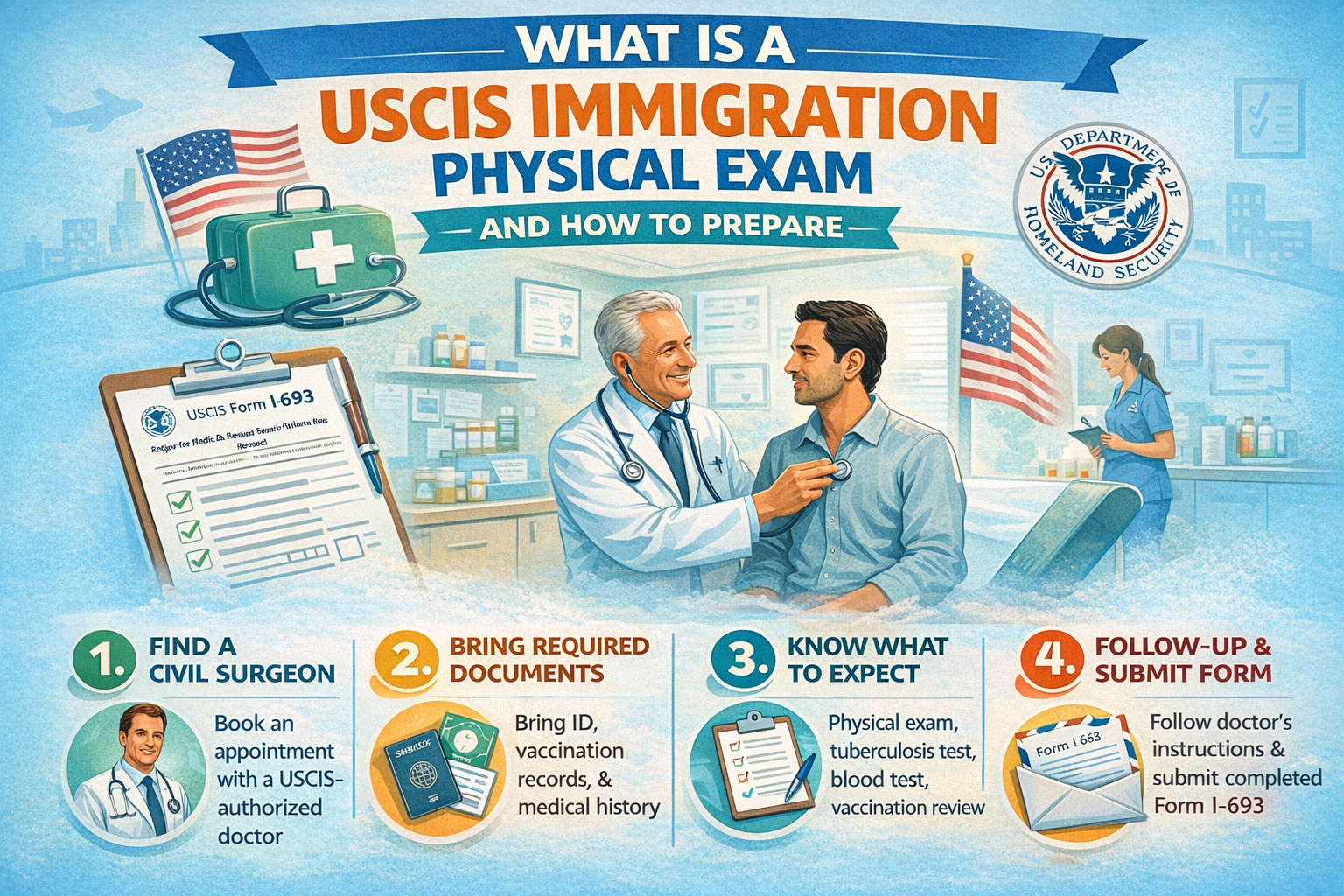
If you’re applying for a green card or adjusting your immigration status in the United States, you must have heard about the USCIS immigration physical exam. People often get confused in this step and are also intimidated. Because they don't have knowledge about what happens during the immigration exam, what documents are needed, how long it takes and most importantly, how to make sure everything goes smoothly. For all these queries, you need to understand the USCIS immigration physical exam. So let’s understand its concept in detail and clear up all your confusion.
What Is a USCIS Immigration Physical Exam?
A USCIS immigration physical exam, also called an immigration medical exam, is a required health screening for people applying for lawful permanent residence (a green card) or certain other immigration benefits in the U.S. USCIS means U.S. Citizenship and Immigration Services.
If you are within the U.S., then it is required that the exam be completed by a USCIS-designated civil surgeon and documented on Form I-693, which is the official medical form required by the U.S. Citizenship and Immigration Services.
But if you are applying from outside, then authorized physicians by the U.S. Department of State conduct it. The purpose isn’t to judge your overall health. It’s simply to make sure you:
-
Don’t have certain communicable diseases that pose a public health risk
-
Have received required vaccinations
-
Don’t have medical conditions that would make you inadmissible under U.S. immigration law
That’s it. It’s not a fitness test. It’s not a full-body medical overhaul. It’s a standardized medical clearance process. So consider it just a test.
Who Needs an Immigration Medical Exam?
You’ll likely need a USCIS medical exam if you are:
-
Applying for a
-
Applying for an immigrant visa from outside the U.S.
-
Required by USCIS to submit Form I-693
-
A refugee adjusting status after one year in the U.S.
If you’re unsure whether you need one, your immigration attorney or USCIS instructions will tell you. But in most green card cases, this step is mandatory.
What Happens During the Immigration Physical?
This question is very common, and all people want to know it before going for the exam and it's also good to have knowledge.
Review of Medical History
Your provider will ask about:
-
Past medical conditions
-
Hospitalizations or surgeries
-
Mental health history
-
Substance use history
-
Vaccination records
Be honest here. The doctor isn’t there to judge you. They’re there to document required information accurately and if you have any health issues, then they provide you with a solution accordingly.
Physical Examination
The physical exam is very simple and similar to a routine check-up. It includes:
-
Checking blood pressure
-
Listening to your heart and lungs
-
Checking eyes, ears, nose, and throat
-
Basic abdominal exam
-
General physical assessment
It's just a part of the evaluation and never takes a long time.
Required Testing
Certain tests are mandatory for immigration clearance, including:
-
Tuberculosis (TB) screening
-
Syphilis blood test
-
Gonorrhea test (urine test)
-
Additional testing, if needed based on age or risk factors
Depending on your age and health history, chest X-rays are required if TB screening results are positive.
Vaccination Review
This part is very important.
USCIS requires specific vaccines depending on age, including:
-
MMR (Measles, Mumps, Rubella)
-
Tdap (Tetanus, Diphtheria, Pertussis)
-
Varicella (Chickenpox)
-
Influenza (seasonal)
-
COVID-19 (if required under current guidelines)
If you don’t have proof of vaccination, you need to take the missing vaccines during your visit. But now USCIS has removed the requirement of COVID-19 vaccination from Form I-693, so it’s not necessary.
Important Information About the Immigration Medical Exam for Women
Immigration medical exam is the same for women but still, women have some concerns. You have to know that being on your period does not automatically prevent you from completing the immigration medical exam. However, for urine-based gonorrhea testing, heavy menstruation can occasionally affect results.
If you’re pregnant, tell the civil surgeon before testing begins.
-
Certain vaccines can be postponed during pregnancy.
-
If a chest X-ray is required for TB screening, protective shielding will be used, or the X-ray can be delayed depending on medical guidance.
-
Pregnancy itself does not disqualify you from passing the immigration medical exam.
Many pregnant applicants complete the process safely without complications. The major thing is communication.
How to Prepare for Your Immigration Medical Exam
Bring Proper Identification
You’ll need:
-
Government-issued photo ID like a passport, driver’s license, etc.
-
Any USCIS paperwork requesting the exam, if applicable.
Bring Vaccination Records
This is the most common issue we see. If you have:
-
Childhood immunization records
-
School vaccine records
-
Prior medical records
-
Overseas vaccination documents
Bring them all.
In case your documents are in another language, you need certified translations. In this step, the more documentation you provide, the fewer vaccines you’ll likely need.
Bring Form I-693 (If Required)
Some clinics provide the form. And if you don't have one, then others ask you to bring it. So you have to check it beforehand.
Don’t Schedule Too Early
Form I-693 has a validity period. If you complete the exam too early and don’t submit your application within the allowed timeframe, you need to repeat the exam. Timing also matters here so plan carefully.
Eat and Hydrate Normally
Most immigration medical exams don't require fasting unless otherwise directed.
How Much Does a USCIS Immigration Physical Cost?
Costs depend on the clinic and location. Common pricing includes:
-
Physical exam
-
Required lab testing
-
Completion of Form I-693
Vaccinations can be an additional cost if needed. Estimated customers pay between $100 and $500. And you have to pay yourself because there's no government funding for the immigration physical exam.
How Long Does the Immigration Medical Exam Take?
The appointment itself takes 30–60 minutes. The thing that takes time is lab results that take a few days but it depends on the required tests. Once everything is complete, the civil surgeon fills out and seals your Form I-693 in an official envelope and you have never opened it. USCIS will only accept it sealed. In many cases, patients receive their completed paperwork within a week.
What Happens After the Exam?
Once your results are complete:
-
Form I-693 is completed by the civil surgeon.
-
An official envelope is used to seal the form.
-
You submit it to USCIS with your immigration application or bring it to your interview if needed.
But never open the sealed envelope.
Health-Related Reasons for Denial
An immigration medical exam is not like a strict test that will fail you with a single mistake; it means that they will eliminate people based on general health issues. USCIS focuses on specific categories defined under immigration law.
Communicable Diseases of Public Health Significance
These include:
-
Active tuberculosis (TB)
-
Untreated syphilis
-
Untreated gonorrhea
-
Certain other serious communicable diseases
If you test positive for one of these, it does not always mean permanent denial. Most of the time, treatment is required before clearance can be granted. Once properly treated, many applicants move forward without issue.
Failure to Show Required Vaccinations
If you refuse any required vaccines without an approved waiver, it could result in inadmissibility. But mostly missing records alone won’t cause denial. You can receive vaccines during your appointment.
Physical or Mental Disorders Associated with Harmful Behavior
USCIS can deny an application if a person has a physical or mental disorder that can cause harmful behavior that recurs. For example:
-
History of violence tied to a psychiatric condition
-
Substance abuse with associated harmful conduct
This is assessed carefully and individually. Stable and treated conditions generally do not cause automatic denial.
Drug Abuse or Addiction
Current drug abuse or addiction is a major reason for medical inadmissibility. If you used it in the past, it doesn’t automatically disqualify you. The civil surgeon evaluates whether it meets the criteria for a current substance abuse disorder.
What Does NOT Cause Denial?
People also have some myths about the immigration exam denial so they are scared of it.
You will not be denied simply for:
-
Being pregnant
-
Having diabetes
-
High blood pressure
-
Being overweight
-
Having had surgery
-
Having controlled mental health conditions
-
Past cancer (if treated and stable)
USCIS is not screening for perfect health. They’re screening for specific public health risks.
How Long Is the Immigration Medical Exam Valid?
After the civil surgeon signed Form I-693, it was normally valid for a certain amount of time (USCIS updates guidelines infrequently). However, if it is given to USCIS after 2023, it becomes valid for life. But For overseas clients, the validity period is typically six months, however it can be shortened by up to three months in the case of a disease like tuberculosis. But always verify current rules before scheduling. Submitting it within the required timeframe is crucial to avoid delays.
Common Concerns About the Immigration Physical Exam
Let’s answer the main concerns of people.
What if I test positive for TB?
Not all positive TB tests mean you’re inadmissible. It requires additional testing, such as a chest X-ray. Many cases are treatable or manageable.
What if I don’t have my vaccination records?
You need blood tests (titers) to check immunity or receive missing vaccines. It’s fixable.
Will a past medical condition disqualify me?
Most health conditions do not disqualify applicants. USCIS is mainly concerned about communicable diseases of public health significance and certain mental health conditions linked to harmful behavior.
Why Choose iMed Urgent Care for Your USCIS Immigration Medical Exam?
When you’re dealing with immigration paperwork, you want everything done the first time correctly. That’s why you need iMed Urgent Care, which has served customers for years. We are conveniently located in Ohio at different locations, including Grove City, East Columbus, and South High Columbus so you can walk in easily. At iMed Urgent Care, we offer:
-
USCIS-designated civil surgeons
-
Fast scheduling and minimal wait times
-
On-site lab testing
-
Vaccinations available on-site
-
Transparent pricing
-
Friendly, multilingual staff
We understand how important this step is in your immigration journey. Our goal is to make the immigration physical exam process simple, efficient, and stress-free.